
Best Dog Food for Chihuahuas (2026): Vet-Backed Guide
July 22, 2026 · 12 min read
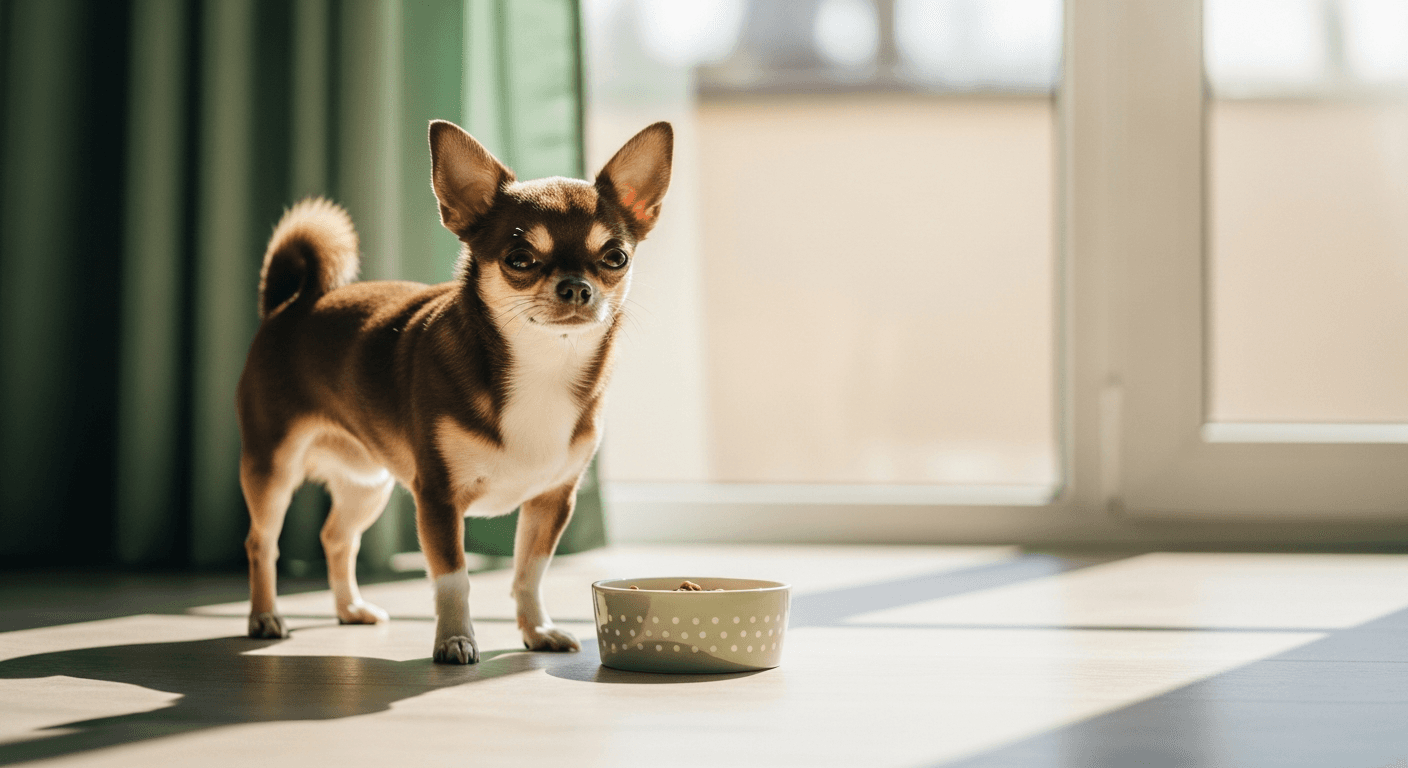
Short answer: the best food for a Chihuahua is a complete-and-balanced small-breed formula with very small kibble, weighed on a kitchen scale rather than scooped. Chihuahuas have the smallest calorie budget of any common breed. Many adults need only 150–250 kcal per day. At that scale, one dental chew can be a third of the day's intake, and the usual advice to "just cut back on treats a bit" is not precise enough to be useful.
Start with the breed's real risks
- Extreme portion sensitivity. The entire daily allowance is smaller than a single meal for a medium dog. Ordinary measurement error becomes a large proportional error.
- Hypoglycemia in puppies. Minimal glycogen reserves plus a high metabolic rate makes low blood sugar a genuine emergency risk in young or very small dogs.
- Periodontal disease. Chihuahuas have a full complement of teeth in one of the smallest jaws in the species. Dental disease is close to universal without active care.
- Patellar luxation. A common breed problem, aggravated directly by excess weight.
- Tracheal collapse. Also seen in the breed and also worsened by extra body weight.
How much to feed a Chihuahua
Adult Chihuahuas typically weigh 3–6 lb. Use RER = 70 × (kg)^0.75, multiplied by about 1.6 for a typical neutered adult pet.
| Chihuahua's weight | Approx. daily calories (adult pet) |
|---|---|
| 3 lb (1.4 kg) | ~145 kcal |
| 4 lb (1.8 kg) | ~175 kcal |
| 5 lb (2.3 kg) | ~205 kcal |
| 6 lb (2.7 kg) | ~235 kcal |
| Active / intact adult | add ~20–25% |
| Senior / low activity | subtract ~10–15% |
Run the exact figure with the dog calorie calculator and convert to your food's density using the portion converter.
A kitchen scale is not optional for this breed. A typical Chihuahua eats roughly 40–60 grams of dry food a day. The variation between a loosely and firmly packed measuring cup can easily be 10 grams, around 20% of the daily ration. There is no way to feed a 4 lb dog accurately by eye.
What this means for treats
| Common treat | Approx. calories | Share of a 4 lb Chihuahua's day (~175 kcal) |
|---|---|---|
| Small dental chew | ~70 kcal | 40% |
| One standard biscuit | ~40 kcal | 23% |
| 1 oz cheddar cheese | ~110 kcal | 63% |
| 1 tbsp peanut butter | ~95 kcal | 54% |
| One baby carrot | ~4 kcal | 2% |
This table is the single most useful thing in this article. A Chihuahua given a dental chew and a couple of biscuits has consumed most of its daily energy before touching its actual food. Which is how a dog eating "hardly anything" becomes overweight.
Break treats into fragments. Chihuahuas respond to the event of being given something, not the quantity. One biscuit can serve as eight training rewards.
Hypoglycemia: know this before you need it
Toy-breed puppies can drop to dangerously low blood glucose after a missed meal, during stress or cold, or with any illness that reduces appetite. Chihuahua puppies, particularly very small ones, are among the most at risk.
Signs: weakness, an unsteady or wobbly gait, glazed eyes, tremors, and in severe cases seizures or collapse.
What to do: rub honey, corn syrup, or glucose gel on the gums, never pour liquid into the mouth of a semi-conscious dog, and contact a veterinarian immediately. Apparent recovery after sugar does not resolve the underlying cause.
Prevention: feed puppies under about four months three to four small meals a day, and very young or very small puppies more often still. Keep a sugar source in the house. Adults are much less susceptible, but an adult Chihuahua that stops eating should be seen promptly. There is very little reserve.
What to look for in the food
Complete and balanced for the life stage
Check the AAFCO adequacy statement, preferring "animal feeding tests" over "formulated to meet." Our label guide shows where to find it and what the wording means.
Genuinely small kibble
A Chihuahua's mouth is tiny and standard kibble is frequently too large to pick up and chew comfortably. This produces dropped food, whole swallowing, and what looks like fussiness. Small-breed formulas use appropriately sized kibble: a real design difference, not marketing.
Adequate calorie density
Small-breed foods tend to be more calorie-dense per gram, which lets a small stomach meet a fast metabolism's needs. Useful, and another reason weighing matters, since dense food packs more calories into small errors.
Nutrient targets for an adult Chihuahua
| Nutrient | Adult target (dry matter) | Why it matters |
|---|---|---|
| Crude protein | 25–30% | Maintains lean mass on a very small frame |
| Crude fat | 12–18% | Energy density for a high metabolic rate |
| Omega-3 (EPA + DHA) | ≥ 0.3% combined | Skin and coat |
| Calcium | AAFCO adult range | Never supplement on a complete food |
Reference points for comparing labels, not a prescription.
Dental disease: the breed's defining long-term problem
Chihuahuas have the same 42 adult teeth as a German Shepherd, packed into a dramatically smaller jaw. Crowding traps plaque, retained deciduous teeth make it worse, and the breed's long lifespan gives disease decades to progress. Periodontal disease is painful, causes tooth loss, and drives systemic inflammation.
What helps modestly: dental-format kibble designed to be chewed rather than swallowed, and VOHC-accepted dental products. Counted within the calorie budget, which as the table above shows is a serious constraint at this size.
What actually protects the teeth: daily brushing with dog toothpaste, ideally introduced in puppyhood, plus professional cleaning under anesthesia as your veterinarian advises. Owners are often sold "dental" diets as a substitute for brushing. They are not one.
Keeping a Chihuahua lean
The proportions here are unforgiving. A 1 lb gain on a 4 lb dog is 25% of body weight, the equivalent of a 70 lb Labrador gaining nearly 18 lb.
- Score body condition by hand every couple of weeks. Ribs easily felt under thin fat, a visible waist from above, an abdominal tuck from the side.
- Weigh the dog on a kitchen or baby scale. Ounces are meaningful at this size; a veterinary scale visit every few months is a reasonable alternative.
- Cap treats at about 15–25 kcal a day and subtract them from meals.
- Feed two to three scheduled meals instead of free-feeding, so appetite changes stay visible.
Excess weight worsens patellar luxation and tracheal collapse, both of which the breed already tends toward. If your Chihuahua needs to slim down, our weight loss guide covers safe targets and rate of loss, with the caveat that at this size, a veterinarian should be involved in setting the numbers.
What does not deserve your attention
- "Chihuahua" on the package. A marketing segment, not a regulated nutritional category. Kibble size may genuinely suit the breed; the nutrition is ordinary small-breed food.
- Grain-free by default. A formulation choice, not a health upgrade, and the subject of an ongoing FDA inquiry into diet-associated heart disease. See our grain-free guide.
- Human food "just a little bit." At 175 calories a day, there is no such thing as a little bit. This is the breed where table scraps do the most damage.
- Star ratings from review aggregators. They grade ingredient lists for an average dog, not a 4 lb toy breed. Here is why those ratings mislead.
The bottom line
For a Chihuahua, "best food" means complete and balanced for the life stage, small enough to physically eat, and, overwhelmingly, weighed. The breed's daily calorie budget is so small that portioning discipline and treat arithmetic determine body condition far more than which bag you buy.
Add early and consistent dental care, and a plan for puppy hypoglycemia, and you have addressed the three things that actually shape a Chihuahua's long-term health.
The right specific product depends on your dog's age, weight, dental status, and any diagnosed conditions. IntelliBowl builds a shortlist around your dog rather than the breed average. See the dog food recommendations hub.
Get a food plan matched to your Chihuahua; free, 60 seconds →
FAQ
Quick answers sourced from veterinary literature
These mirror the medically reviewed IntelliBowl notes on this slug and exist to help crawlers summarize quotable excerpts.
How much should I feed a Chihuahua?
Most adult Chihuahuas weigh 3–6 lb and need roughly 150–250 kcal per day. Use RER = 70 × (kg)^0.75 and multiply by about 1.6 for a typical neutered adult: a 4 lb (1.8 kg) Chihuahua has an RER near 109 kcal, giving a target around 175 kcal. Measuring cups are simply too imprecise at this scale. A kitchen scale and grams is the only reliable approach.
Why is my Chihuahua puppy shaky or weak?
Suspect hypoglycemia and treat it as urgent. Toy-breed puppies have minimal glycogen reserves and can crash after a missed meal, during stress, cold, or illness. Signs include wobbliness, weakness, glazed eyes, tremors, and collapse. Rub honey or corn syrup on the gums and contact a veterinarian immediately. Prevent it by feeding small meals every 3–4 hours in young puppies rather than two large ones.
Do Chihuahuas need small-breed food specifically?
The kibble size genuinely matters. A Chihuahua's mouth is tiny and standard kibble is often difficult to pick up and chew. Small-breed formulas also tend to be more calorie-dense per gram, which suits a fast metabolism in a small stomach. The nutritional differences beyond that are modest, so treat 'small breed' as a physical design feature worth having rather than a distinct nutritional category.
Why do Chihuahuas have such bad teeth?
They have a full complement of teeth crowded into one of the smallest jaws in the species, which traps plaque and drives early periodontal disease. Retained baby teeth are common and worsen crowding. Periodontal disease is painful and can seed systemic inflammation. Diet plays a limited supporting role; daily brushing and veterinary dental care are what protect a Chihuahua's mouth, ideally started in puppyhood.
Is my Chihuahua overweight?
Percentages are brutal at this size. A 1 lb gain on a 4 lb dog is 25% of body weight, equivalent to a 70 lb dog gaining nearly 18 lb. Use body condition scoring: ribs easily felt under thin fat, a visible waist from above, an abdominal tuck from the side. Excess weight worsens patellar luxation and tracheal collapse, both of which the breed is already predisposed to.
Can Chihuahuas eat regular adult dog food?
Nutritionally, a complete-and-balanced adult maintenance food is appropriate. The practical obstacles are kibble size, which many Chihuahuas physically struggle with, and calorie density, since a food designed for large dogs may need portions too small to be measured accurately. A small-breed formula solves both. What matters most is the AAFCO adequacy statement matching your dog's life stage.
How often should a Chihuahua eat?
Adults do well on two to three measured meals daily. Puppies under about four months need three to four meals to guard against hypoglycemia, and very small or young puppies may need more. Consistent scheduled meals also make appetite loss visible, which is an important early illness signal in a breed where a single skipped meal is a meaningful fraction of intake.