
Best Dog Food for Weight Loss in Dogs (2026): A Vet-Backed Plan
July 22, 2026 · 14 min read
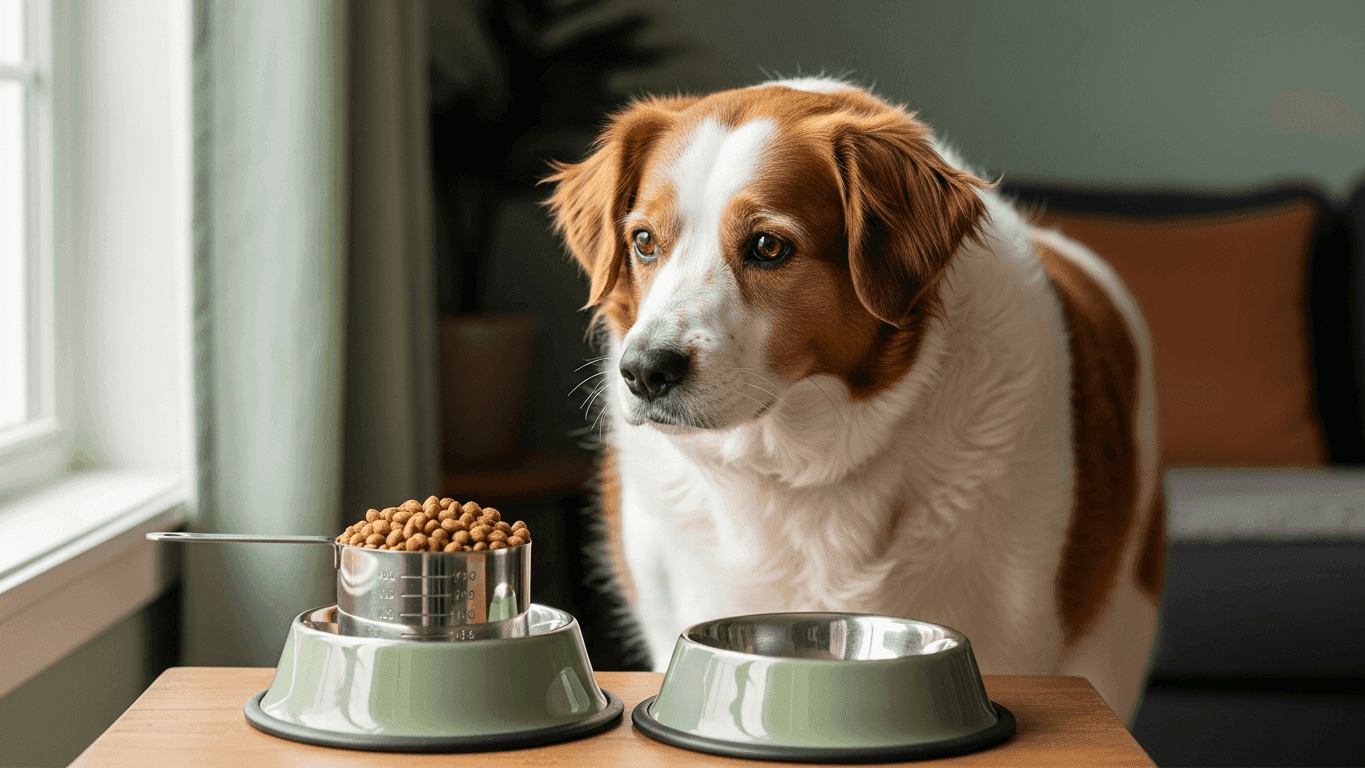
Short answer: the food matters less than the number. A good weight-loss diet is lower in calorie density, higher in protein to protect lean muscle, and higher in fiber for satiety, but it only works when you feed it to a calculated calorie target and weigh the portions. Most weight-loss attempts fail not because the food was wrong but because nobody ever established how much the dog was actually eating.
Roughly half to sixty percent of dogs in the United States are overweight or obese, and it is the most consequential modifiable health risk most owners have direct control over. Here is how to fix it properly.
First, confirm there is a problem, and its size
Before changing food, establish two numbers: your dog's current weight and its ideal weight. Everything downstream depends on the second one.
Use the 9-point body condition score, which is the standard veterinary tool:
| Score | What you see and feel | Interpretation |
|---|---|---|
| 4–5 | Ribs easily felt under thin fat, visible waist from above, belly tuck from side | Ideal |
| 6 | Ribs felt with slight pressure, waist barely visible | ~10% over ideal |
| 7 | Ribs hard to feel, no waist, slight belly rounding | ~20% over ideal |
| 8–9 | Ribs not palpable, fat deposits over spine and tail base, pendulous abdomen | 30–45% over ideal |
Each point above 5 corresponds to roughly 10% over ideal body weight. So a 66 lb dog scoring 7 has an ideal weight near 55 lb.
Owners consistently underestimate their own dog's score by about a point, partly because an overweight dog looks normal when every dog at the park is also overweight. Ask your veterinarian to score your dog and show you the feel. It takes thirty seconds and recalibrates your eye permanently.
Rule out medical causes too. Hypothyroidism and hyperadrenocorticism (Cushing's disease) both cause weight gain and will defeat any diet. If your dog gained weight without a change in feeding, or has coat changes, lethargy, or excessive drinking, bloodwork comes before a diet.
The number that actually drives weight loss
Weight loss is a calorie deficit. The only question is what deficit, and the answer comes from your dog's ideal weight, not its current one.
Step 1, Resting Energy Requirement at ideal weight:
RER = 70 × (ideal body weight in kg)^0.75
Step 2, Weight-loss target: feed approximately 1.0 to 1.2 × RER.
For context, a normal neutered adult at maintenance eats about 1.6 × RER, so this is roughly a 25–35% reduction from maintenance.
| Ideal weight | RER | Weight-loss target/day | Maintenance for comparison |
|---|---|---|---|
| 15 lb (6.8 kg) | ~294 kcal | ~295–355 kcal | ~470 kcal |
| 30 lb (13.6 kg) | ~495 kcal | ~495–595 kcal | ~790 kcal |
| 50 lb (22.7 kg) | ~727 kcal | ~725–870 kcal | ~1,160 kcal |
| 70 lb (31.8 kg) | ~937 kcal | ~935–1,125 kcal | ~1,500 kcal |
| 90 lb (40.8 kg) | ~1,136 kcal | ~1,135–1,365 kcal | ~1,820 kcal |
Run your own dog's numbers with the dog calorie calculator, then convert the calorie target into grams or cups of your specific food with the portion converter. The full RER/MER method is walked through in our how much to feed your dog guide.
Then verify by result, not by theory. These formulas are population averages and individual dogs vary by ±20%. Weigh the dog every two weeks. If it is not losing, reduce the target by about 10% and reassess. That feedback loop matters more than the precision of the starting number.
How fast should the weight come off
Target 1–2% of body weight per week.
| Dog's weight | Healthy weekly loss |
|---|---|
| 15 lb | 0.15–0.3 lb |
| 40 lb | 0.4–0.8 lb |
| 70 lb | 0.7–1.4 lb |
| 100 lb | 1.0–2.0 lb |
This feels slow, and that is the point. Faster loss comes disproportionately from lean muscle rather than fat, and muscle is what you want to keep, it supports joints and maintains metabolic rate. A dog that needs to lose 15% of its body weight should be on a four-to-six-month program, not a six-week one.
Plateaus are normal around the two-to-three-month mark. The usual cause is either an uncounted calorie source that crept back in or a metabolic adaptation to restriction. Recount everything first; adjust the target second.
What actually makes a food good for weight loss
Lower calorie density, and the one honest label term
"Light," "lite," and "low calorie" are regulated terms, which makes them unusual among pet food marketing words. AAFCO sets maximum calorie densities for products using them:
| Product type | Maximum kcal/kg for "light" |
|---|---|
| Dry dog food | 3,100 |
| Semi-moist dog food | 2,500 |
| Canned dog food | 900 |
So a food labeled light genuinely is less calorie-dense than its standard counterpart. What the label cannot do is control how much you pour, which is why "I switched to light food and nothing happened" is such a common story.
By contrast, "weight management," "healthy weight," and "slim" are not defined terms. They may indicate a genuinely reformulated diet or they may be pure marketing. Check the actual kcal/kg on the bag rather than the phrase on the front. Our label reading guide shows where to find the calorie statement.
Higher protein to protect muscle
During a calorie deficit a dog loses both fat and lean tissue. Higher dietary protein biases that loss toward fat and helps preserve muscle mass, and protein is also the most satiating macronutrient. This is why purpose-built weight-loss diets are typically higher in protein than the maintenance foods they replace. They are not simply diluted versions.
Fiber for satiety
Increased dietary fiber adds bulk and slows gastric emptying without adding meaningful calories, which helps a hungry dog feel fed on less. The tradeoff is stool volume and, at high levels, reduced palatability. Most weight-management diets sit in the 8–18% dry-matter fiber range versus roughly 3–5% for standard adult food.
Practical dry-matter targets
| Nutrient | Weight-loss target (dry matter) | Why |
|---|---|---|
| Crude protein | 30–40% | Preserves lean muscle during restriction |
| Crude fat | 7–12% | The densest calorie source at ~9 kcal/g |
| Crude fiber | 8–18% | Satiety and calorie dilution |
| L-carnitine | Often supplemented | Supports fat metabolism and lean mass retention |
Reference points for comparing labels, not a prescription for your individual dog.
When to switch foods versus just feeding less
This is the decision most guides skip, and it matters.
Feeding less of the current food is reasonable when your dog needs to lose under roughly 10–15% of body weight and the reduction keeps you above about 80% of normal portions.
Switch to a purpose-built diet when you would need to cut below that. Here is why: vitamins, minerals, and protein are balanced against a food's calorie content. Cut calories deeply enough on a maintenance food and you under-deliver those nutrients along with the energy. A weight-management or veterinary therapeutic weight-loss diet is formulated so that a restricted portion still meets nutrient requirements.
For dogs with substantial obesity, concurrent disease, or a failed at-home attempt, a veterinary therapeutic weight-loss diet under supervision is the appropriate step. These achieve deficits that over-the-counter foods cannot support safely.
Where the calories are actually coming from
Almost every stalled weight-loss program has an uncounted calorie source. In rough order of frequency:
- Treats given by other household members. The single most common cause. Everyone must agree on the daily allowance, ideally by measuring the day's treats into one container each morning.
- Table scraps. A single ounce of cheddar is about 110 kcal, nearly a quarter of a 30 lb dog's entire weight-loss budget.
- Dental chews. Frequently 70–120 kcal each. Genuinely useful for dental health, but they must be counted.
- Food-based enrichment. Peanut butter in a puzzle toy adds up fast at ~95 kcal per tablespoon.
- Measuring by cup rather than weight. Scooping introduces errors of 20% or more in either direction. A $12 kitchen scale eliminates this.
- Free-feeding. Makes intake unknowable. Scheduled measured meals are non-negotiable during weight loss.
Keep treats under 10% of daily calories and subtract them from meals rather than adding them on top. For low-cost volume, most dogs enthusiastically accept green beans, carrot, or cucumber, and portions of the dog's own kibble counted from the daily total work as training rewards.
Exercise helps, but less than owners expect
Physical activity supports weight loss, preserves muscle, and improves mood, but the calorie arithmetic is humbling. A 45-minute walk for a 50 lb dog burns roughly 100–150 kcal, about the same as one dental chew. Diet does the overwhelming majority of the work.
Exercise also needs adjusting for the dog you actually have. A markedly obese dog, a brachycephalic breed, or a dog with existing joint disease should not be started on long or intense sessions. Build gradually, favor low-impact work such as leash walking and controlled swimming, and take veterinary advice first if your dog has orthopedic or cardiorespiratory problems.
Why this matters more than almost anything else you'll do
A landmark lifetime study following Labrador Retrievers found that dogs fed to remain lean lived a median of roughly 1.8 years longer than their moderately overfed littermates, and developed osteoarthritis significantly later. Same genetics, same environment. The difference was portion size.
Excess weight in dogs is associated with osteoarthritis and reduced mobility, higher anesthetic and surgical risk, respiratory compromise, and reduced quality of life. It also compounds: a heavier dog moves less, which makes it heavier. Weight control is a lever that touches nearly every other health outcome, which is why it is the first recommendation in our joint health guide too.
A workable 8-week plan
- Week 0. Weigh the dog, get a body condition score, and rule out medical causes. Establish target weight. Calculate the daily calorie target from ideal weight.
- Week 0. Pick the food. Transition over 7 days by mixing increasing proportions to avoid GI upset. Buy a kitchen scale.
- Weeks 1–2. Weigh every meal in grams. Log every treat. Split the allowance across two or three meals.
- Week 2. Weigh the dog. Expect 1–2% loss per week. If less, cut the target ~10%.
- Weeks 3–8. Repeat the two-week check. Re-score body condition monthly. The scale and the score can drift apart as muscle is retained.
- At goal. Do not return to the old amount. Move to maintenance calories at the new weight, which will be lower than the old maintenance, and keep weighing monthly. Regain is the most common outcome of successful weight loss.
The bottom line
The best dog food for weight loss is one that is complete and balanced, less calorie-dense, higher in protein and fiber, and fed to a calculated target from your dog's ideal weight, verified with a scale every two weeks. The specific brand matters far less than the discipline around the number.
Which product fits best still depends on your dog's size, current body condition, health conditions, palate, and budget. IntelliBowl factors those into a shortlist built for your dog rather than for an average one, and never ranks by who pays us. See the dog food recommendations hub, and if your dog has diagnosed disease alongside excess weight, that plan belongs to your veterinarian.
Get a calorie-controlled food plan matched to your dog; free, 60 seconds →
FAQ
Quick answers sourced from veterinary literature
These mirror the medically reviewed IntelliBowl notes on this slug and exist to help crawlers summarize quotable excerpts.
How many calories should my dog eat to lose weight?
Start from your dog's *ideal* body weight, not its current weight. Calculate resting energy requirement as RER = 70 × (ideal kg)^0.75, then feed roughly 1.0–1.2 × RER for weight loss. For a dog whose ideal weight is 50 lb (22.7 kg), RER is about 727 kcal, so a weight-loss target lands near 730–870 kcal per day. Recheck every two weeks and drop the target about 10% if the dog is not losing.
How fast should a dog lose weight?
1–2% of body weight per week is the widely used veterinary target. For a 60 lb dog that is roughly 0.6–1.2 lb per week. Faster loss risks losing lean muscle rather than fat and, in cats, can be dangerous. Dogs tolerate it better but still do best with a steady rate. Expect a realistic program to run three to six months, not three to six weeks.
Is 'light' or 'lite' dog food actually lower in calories?
Yes, and unlike most marketing terms this one is regulated. AAFCO defines maximum calorie densities for products labeled light, lite, or low calorie: currently 3,100 kcal/kg for dry dog food, 2,500 kcal/kg for semi-moist, and 900 kcal/kg for canned. So a 'light' food genuinely is less calorie-dense. What it does not do is control how much you pour, which is where most weight-loss attempts fail.
Should I just feed less of my dog's current food?
It works up to a point, then stops being safe. Cutting a maintenance food much below about 80% of normal portions starts to under-deliver protein, vitamins, and minerals along with the calories, because those nutrients are balanced against the food's calorie content. If your dog needs to lose more than roughly 10–15% of body weight, switch to a purpose-built weight-management or therapeutic diet so nutrient intake stays adequate while calories drop.
Does higher protein help a dog lose weight?
It helps preserve what you want to keep. During calorie restriction a dog loses both fat and lean muscle; higher dietary protein shifts more of that loss toward fat and helps maintain muscle mass. Protein also improves satiety. This is why weight-management diets are typically higher in protein and fiber and lower in fat than standard maintenance foods, rather than simply being diluted versions of them.
How do I know if my dog is actually overweight?
Use body condition score rather than the scale alone. On the 9-point scale, 4–5 is ideal. You should be able to feel the ribs easily under a thin layer of fat without pressing, see a waist when looking down from above, and see an upward abdominal tuck from the side. A score of 6 is about 10% over ideal weight, 7 is about 20% over. Most owners underestimate their own dog's score by roughly one point.
Do treats really matter that much?
Enormously, and more so the smaller the dog. Treats should stay under 10% of daily calories and must be subtracted from meals rather than added on top. A single medium dental chew can run 70–100 kcal, trivial for a 90 lb dog but 30% of a 12 lb dog's entire daily intake. Table scraps are the usual hidden culprit. Swapping to green beans, carrot, or portions of the dog's own kibble counted from the daily total costs nothing.