
How Much Does Dog Food Cost Per Month? (2026 Numbers)
September 6, 2026 · 12 min read
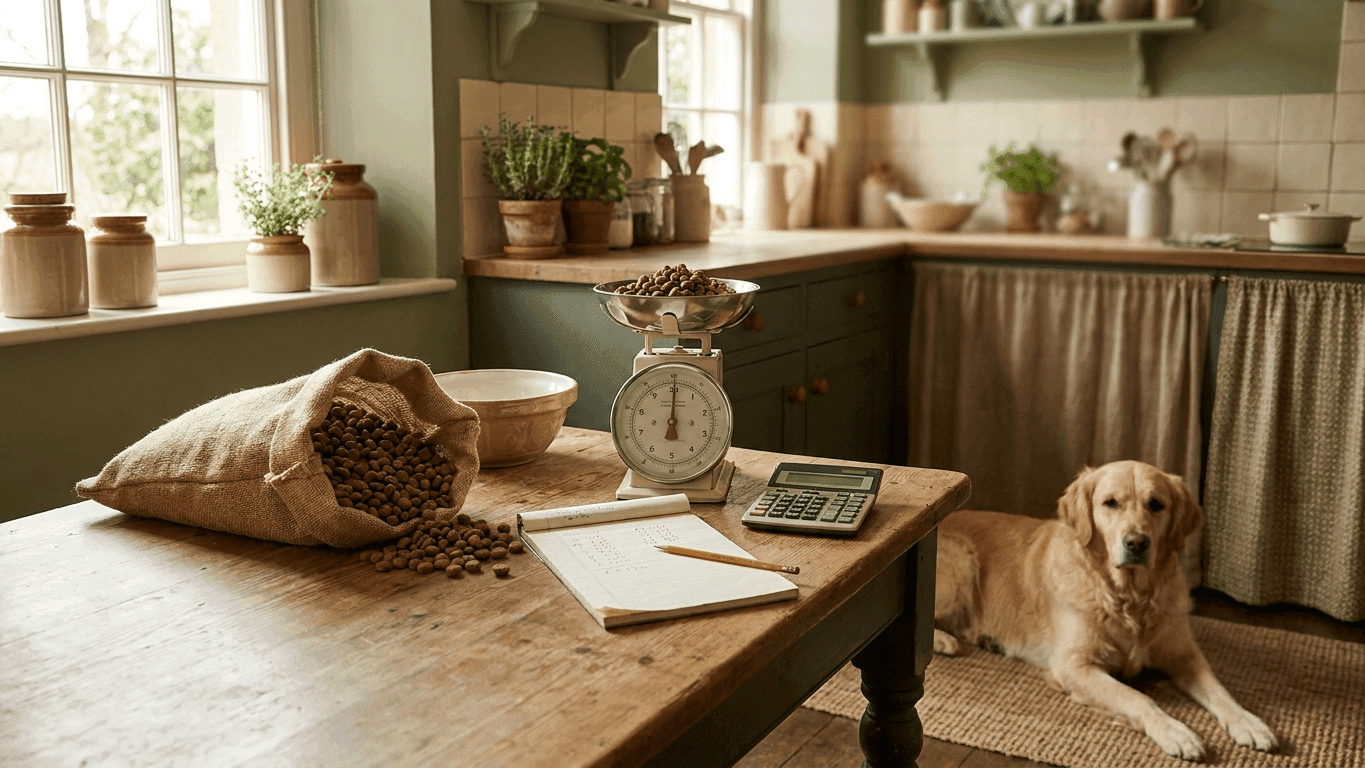
Short answer: feeding a 30 lb dog dry food costs roughly $17 to $43 a month in 2026, and a 70 lb dog roughly $32 to $82. The spread inside each row comes from brand tier, not from your dog. Fresh subscription food runs three to eight times those figures.
Most people compare dog foods by the price on the bag. That number tells you almost nothing, because bags differ in weight and foods differ in how many calories they pack per kilogram. The comparison that works is cost per 1,000 calories.
What it actually costs, by dog size
These figures assume a neutered adult dog of moderate activity, using standard maintenance energy formulas and a dry food at 3,800 kcal/kg. The three price columns are value, mid-tier, and premium dry food.
| Dog weight | Calories/day | Calories/month | Value ($0.70) | Mid ($1.20) | Premium ($1.80) |
|---|---|---|---|---|---|
| 10 lb | ~350 | ~10,600 | $7 | $13 | $19 |
| 30 lb | ~795 | ~24,100 | $17 | $29 | $43 |
| 50 lb | ~1,165 | ~35,400 | $25 | $42 | $64 |
| 70 lb | ~1,500 | ~45,500 | $32 | $55 | $82 |
| 90 lb | ~1,810 | ~55,000 | $38 | $66 | $99 |
The tier column moves the bill more than the dog does. A 30 lb dog on premium food costs more to feed than a 90 lb dog on value food.
Over a year, moving a 70 lb dog from a value bag to a premium one costs about $600. That is a real decision, and it deserves a real reason.
Your dog's actual number depends on age, activity, neuter status, and body condition. Run it through the dog calorie calculator, then price it with the dog food cost calculator.
Cost per calorie, and how to work it out
Take any bag and do this:
- Bag price ÷ bag weight in kg gives cost per kg.
- Cost per kg ÷ the food's kcal per kg gives cost per calorie.
- Multiply by 1,000.
The kcal/kg figure is on the bag or on the manufacturer's site. If a brand will not publish it, that is worth noticing on its own.
Here is why it matters. A denser food costs more per bag and feeds more days:
| Bag | Price | Calories in bag | Cost per 1,000 kcal |
|---|---|---|---|
| 13.6 kg at 3,800 kcal/kg | $55 | 51,680 | $1.06 |
| 6.8 kg at 3,800 kcal/kg | $32 | 25,840 | $1.24 |
| 2.0 kg at 3,800 kcal/kg | $14 | 7,600 | $1.84 |
Same food, three sizes. The small bag costs 74% more per calorie than the large one. Owners of small dogs pay this penalty constantly, because a 13.6 kg bag would take a chihuahua half a year to finish.
Where the money actually goes
Bag size
Buying larger saves 15 to 30% per calorie on nearly every product. The limit is freshness: fats begin oxidising once a bag is opened, and a bag that takes four months to finish will taste stale and lose vitamin potency well before the end.
The practical rule is to buy the largest bag your dog finishes in about six weeks. Keep the food in its original bag inside a sealed container, since the bag's liner is a fat barrier and a plastic bin alone is not.
Format
| Format | Cost per 1,000 kcal | 30 lb dog, monthly |
|---|---|---|
| Dry | $0.70 to $1.80 | $17 to $43 |
| Canned | $3.00 to $6.00 | $72 to $145 |
| Fresh, subscription | $4.00 to $9.00 | $96 to $217 |
Canned food is expensive because roughly three quarters of what you are shipping is water. That is a packaging cost rather than a nutritional upgrade, which the wet vs dry comparison goes through in detail.
Treats
Easy to overlook and frequently 10 to 20% of the food budget. Treats should stay under 10% of daily calories anyway, so trimming them usually improves both the bill and the dog. For most owners this saves more than switching brands would.
Does paying more buy better food?
Weakly, and less often than the price gap suggests.
What the top of the market frequently sells is ingredient marketing: exotic proteins, grain-free formulations, ingredient lists composed to read well to a human. Some of the most expensive boutique foods come from companies that employ no veterinary nutritionist, run no feeding trials, and do not own the plant that makes the food.
Meanwhile several mid-priced lines from large manufacturers do all three. That inversion is the single most useful thing to understand about dog food pricing.
The questions worth paying for are the WSAVA criteria:
- A full-time, board-certified veterinary nutritionist on staff
- Recipes designed by a credentialled formulator
- AAFCO feeding trials rather than formulation on paper
- Company-owned manufacturing
- A documented quality-control programme
A food that answers those well at $1.10 per 1,000 calories beats one that answers them poorly at $2.00. Star ratings from review aggregators will not tell you this, because they grade the ingredient list rather than the company, which is why those ratings mislead.
Cutting the bill without cutting quality
- Buy the biggest bag you finish in six weeks. The largest single saving available to most owners.
- Check kcal/kg before switching. A cheaper bag with lower calorie density can cost more per day.
- Portion by weight, not by cup. Scoop error runs 10 to 20% high, which is both money and a slowly heavier dog. The portion converter turns a calorie target into grams.
- Subscribe for the discount, not the format. Autoship on ordinary dry food commonly saves 5 to 10%.
- Cut treats to under 10% of calories.
- Do not buy in bulk beyond six weeks. Rancid fat is a false economy.
What not to do: dilute a good food by feeding less of it. Below roughly 80% of the correct portion you are under-delivering protein, vitamins, and minerals along with the calories. If the food is too expensive, change the food rather than the portion.
The bottom line
Budget $17 to $43 a month for a 30 lb dog and $32 to $82 for a 70 lb dog on dry food, and treat those bands as a brand-tier decision rather than a fixed cost. Compare foods on cost per 1,000 calories, buy the largest bag you finish in six weeks, and spend the difference on a manufacturer that does genuine nutritional work rather than on an ingredient list that reads nicely.
The cheapest good food is usually a mid-priced bag from a large manufacturer, bought big and portioned by weight.
Get a shortlist that fits your dog and your budget; free, 60 seconds →
FAQ
Quick answers sourced from veterinary literature
These mirror the medically reviewed IntelliBowl notes on this slug and exist to help crawlers summarize quotable excerpts.
How much does dog food cost per month?
For dry food in the US in 2026, budget roughly $7 to $19 a month for a 10 lb dog, $17 to $43 for a 30 lb dog, and $32 to $82 for a 70 lb dog. The bands come from brand tier rather than dog size: a value bag runs near $0.70 per 1,000 calories while a premium one runs closer to $1.80, which more than doubles the bill for the same dog. Over a year that gap is about $600 on a 70 lb dog.
Is more expensive dog food actually better?
Price and quality correlate weakly. What you are often buying at the top of the range is ingredient marketing rather than nutritional research, and some of the most expensive boutique foods come from companies that employ no veterinary nutritionist and run no feeding trials. Several mid-priced lines from large manufacturers do both. Judge the manufacturer's nutritional expertise and quality control, then look at the price.
How do I compare dog food prices fairly?
Convert to cost per 1,000 calories. Take the bag price, divide by the bag weight in kilograms, then divide by the food's kcal/kg (on the bag or the brand's site) and multiply by 1,000. A denser food costs more per bag but feeds more days, so a cheaper bag frequently loses on this measure. This is the only comparison that survives across dry, wet, and fresh formats.
Does buying a bigger bag actually save money?
Per calorie, almost always yes. Stepping up one bag size typically saves 15 to 20%, and the gap against the smallest bag is far wider: a 2 kg bag of a food can cost roughly 74% more per calorie than the 13.6 kg bag of the same product. The catch is freshness. Fats begin oxidising once the bag is opened, and a bag that takes a small dog four months to finish will taste stale long before the end. Buy the largest bag your dog finishes in about six weeks, keep it in its original bag inside a sealed container, and the saving is real.
How much does fresh or subscription dog food cost?
Roughly $40 to $95 a month for a 10 lb dog and $180 to $410 for a 70 lb dog, which works out to between three and eight times the cost of dry food per calorie. Portion-controlled delivery genuinely helps some owners manage weight, and palatability is high. What the premium does not buy is a nutritional tier that dry food cannot reach.
What is the cheapest way to feed a dog well?
Buy a mainstream complete-and-balanced dry food from a manufacturer that employs a qualified nutritionist and runs feeding trials, in the largest bag your dog finishes within about six weeks, and portion it by weight against a calculated calorie target. That combination beats most of the expensive options on cost and holds up on nutritional quality. Trimming treats to under 10% of daily calories usually saves more than switching brands.