
Best Dog Food for Rottweilers (2026): Vet-Backed Guide
May 31, 2026 · 14 min read
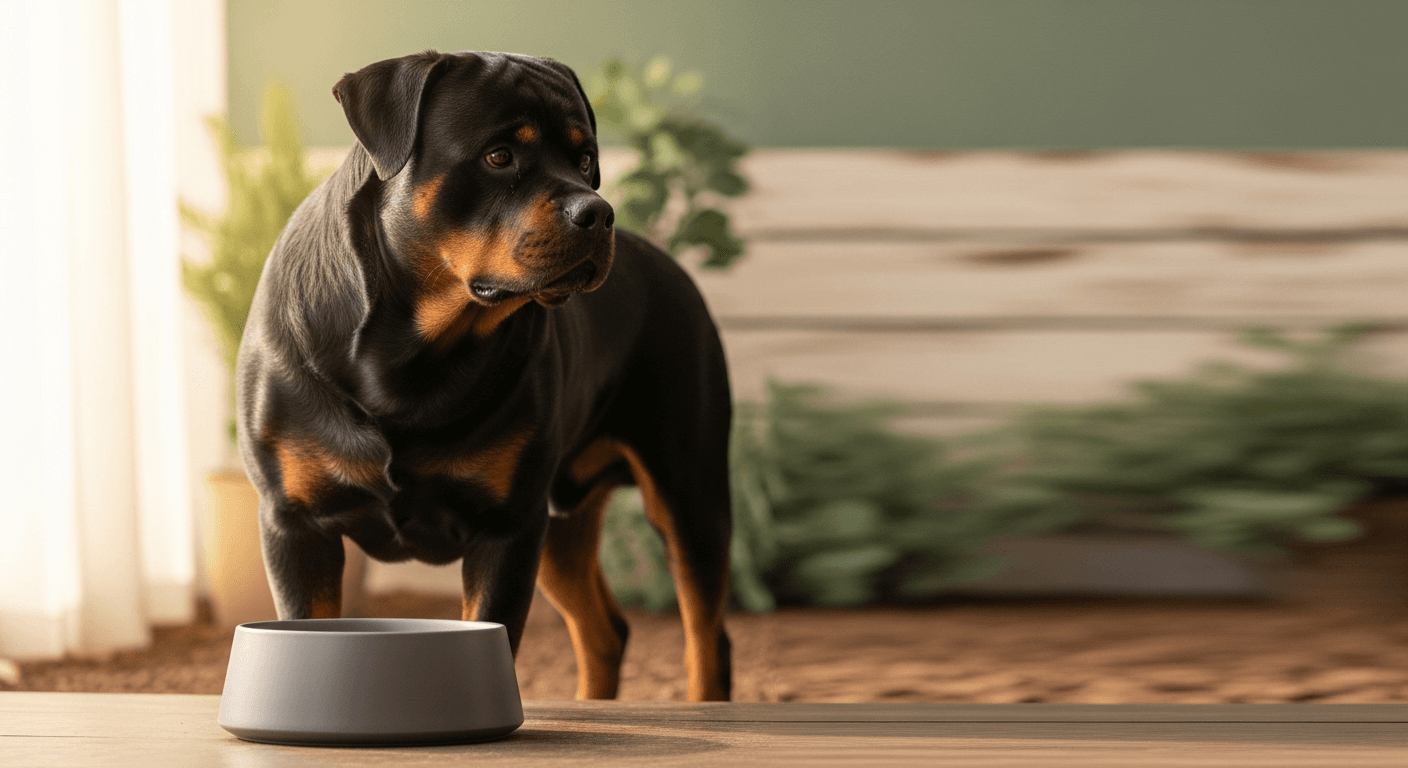
Short answer: the best food for a Rottweiler is a complete-and-balanced, AAFCO feeding-trial-substantiated, large-breed diet matched to life stage, calorie-controlled, and, during puppyhood, strictly growth-controlled. Rotties are a powerful giant-of-the-large breeds with documented risks for hip and elbow dysplasia, cruciate ligament injury, certain cancers, heart conditions, and bloat. The two highest-impact nutrition levers are controlling growth rate as a puppy and keeping the adult lean.
There is no single "Rottweiler" product. Here is what actually matters for the breed.
Start with the breed's real risks
- Orthopedic disease. Hip and elbow dysplasia, osteochondrosis, and cranial cruciate ligament rupture are all over-represented. Growth rate in puppyhood and lifelong lean weight are the dietary levers.
- Rapid large-breed growth. Rottweilers gain mass fast; overfeeding a calorie-dense puppy diet pushes growth too quickly and raises developmental orthopedic disease risk.
- Bloat (GDV). As a large, deep-chested breed, Rotties are at elevated risk of gastric dilatation-volvulus; feeding pattern matters.
- Heart disease and cancer. The breed carries elevated rates of certain cardiac conditions and cancers; no diet prevents these, but lean body condition and a well-formulated diet support overall health.
What to look for in the food
Complete, balanced, and feeding-trial substantiated
Look for an AAFCO statement and prefer "animal feeding tests" wording over "formulated to meet." Our dog food label guide shows where to find it.
Large-breed life-stage formula (this is critical for Rotties)
| Life stage | What the food should be |
|---|---|
| Puppy (to ~18–24 months) | Large-breed puppy formula with controlled calcium and energy density |
| Adult | Large-breed adult maintenance, calorie-controlled |
| Senior | Lower calories as activity drops, protein kept adequate, joint support |
Large-breed puppy food is non-negotiable for a Rottweiler pup. Calcium must sit in the controlled range (1.2–1.8 g/1,000 kcal) and growth should be deliberately paced. Feeding to keep the puppy lean, not maximally grown, is one of the most protective things you can do. See our puppy and AAFCO growth guide.
Joint-supportive nutrients
Large-breed diets often include omega-3 fatty acids (EPA and DHA) and glucosamine/chondroitin. Omega-3s have reasonable evidence for joint comfort; the supplemental compounds are lower-certainty but low-risk. Neither replaces lean body condition or veterinary care for an already-painful joint.
Nutrient targets for a Rottweiler
Practical dry-matter targets for a healthy adult Rottweiler. Reference points for comparing labels, not a prescription.
| Nutrient | Adult target (dry matter) | Why it matters for Rotties |
|---|---|---|
| Crude protein | 25–30% | Lean muscle that supports large joints |
| Crude fat | 12–16% | Energy for a powerful breed; control for pets |
| Calcium (puppy) | 1.2–1.8 g / 1,000 kcal | Controls fast large-breed growth velocity |
| Omega-3 (EPA + DHA) | ≥ 0.3% combined | Joint comfort, skin, and coat |
How much (and how) to feed a Rottweiler
Feed by calories, not the bag's cup range. Figures assume a neutered, moderately active adult on a ~375 kcal/cup food; run the exact number through the dog calorie calculator and convert with the portion converter.
| Rottweiler's weight | Approx. daily calories | Approx. cups/day (375 kcal/cup) |
|---|---|---|
| 80 lb (lean female) | ~1,500 kcal | ~4.0 cups |
| 100 lb (typical adult) | ~1,750 kcal | ~4.7 cups |
| 120 lb (large male) | ~2,000 kcal | ~5.3 cups |
| Working / active line | add 20–50% | ~6–8 cups |
| Senior / low activity | subtract ~15% | ~3.4–4.5 cups |
Bloat-aware feeding pattern matters: split the daily amount into two or three meals rather than one large bowl, avoid hard exercise right around mealtimes, and discuss preventive gastropexy with your veterinarian. Subtract treats from the total and recheck body condition every couple of weeks.
Keeping a Rottweiler lean and sound
- Feed by calories and measure meals: our how-much-to-feed guide has the RER/MER math.
- Pace puppy growth: keep a Rottie puppy lean and growing steadily, not as fast or as big as possible.
- Keep treats under 10% of calories and score body condition every couple of weeks.
- Match calories to the real dog: a pet Rottweiler needs far fewer calories than a working one.
What does not deserve your attention
- "Rottweiler" on the package. Breed-named foods are marketing, not a regulated category; a well-formulated large-breed food can fit better.
- Grain-free by default. A descriptive choice tied to an FDA inquiry into diet-associated heart disease, especially relevant for a breed with cardiac risk, so read the grain-free guide first.
- Star ratings from aggregators. They score an average dog, not your Rottweiler; here is why those ratings mislead.
The bottom line
For a Rottweiler, "best food" means an AAFCO-substantiated, large-breed, calorie-controlled diet. Large-breed puppy formula with paced growth, omega-3s and joint support through life, a bloat-aware feeding pattern, and lifelong lean body condition. Control the growth, keep the dog lean, and feed a manufacturer that does real nutritional work.
The exact best product depends on your dog's age, activity, weight trajectory, and any joint or cardiac history. IntelliBowl factors those into a shortlist built for your Rottweiler, compare it on our dog food recommendations hub.
Get a food plan matched to your Rottweiler; free, 60 seconds →